
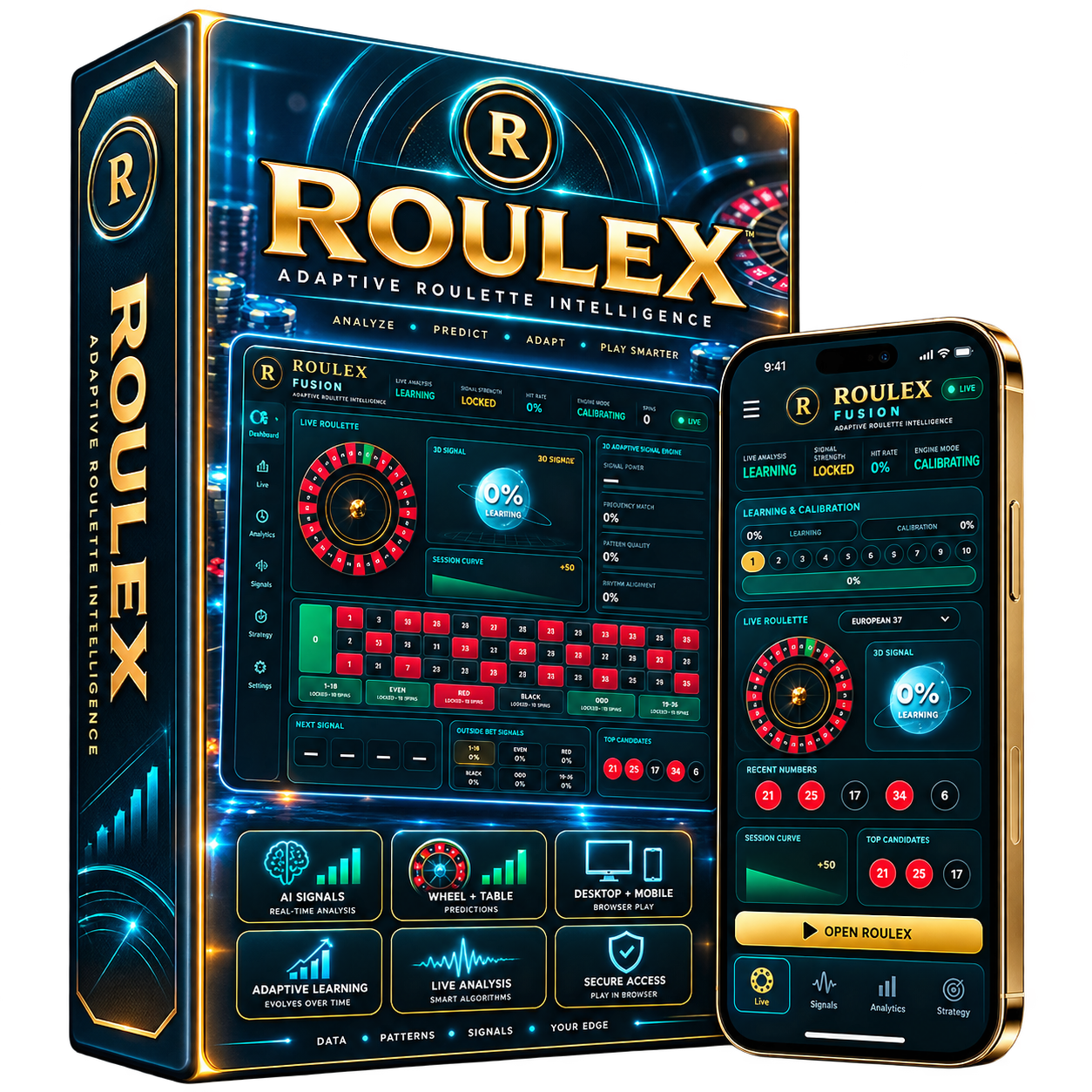
It combines adaptive session analysis, a 28-model analytical ensemble, three-dimensional signal visualization, historical permanence analysis and multi-number overlap detection inside one futuristic responsive interface.
ROULEX was designed to consolidate numerous analytical approaches into one system instead of forcing users to switch between separate strategies and tools.
28-Model Adaptive Ensemble
In STANDARD AI mode, the current roulette session is analyzed simultaneously by 28 different analytical models.
These include approaches based on:
🧠 28 adaptive analytical models
🔵 3D Adaptive Signal Engine
🎯 Live candidate ranking
✨ Pulsating strongest-number signals
🎡 Interactive roulette wheel
🎰 Complete roulette table
📊 Learning & Calibration
🌍 Global Permanence Mode
🔄 Historical transition analysis
6️⃣ 6-Way Overlap Intelligence
📈 Session Curve
💰 Money Management
↩️ Undo Last Action
📱 Desktop + Smartphone Responsive
- frequency
- long-term frequency
- short-term hot activity
- recency
- transition analysis
- deep transitions
- Markov relationships
- pattern matching
- wheel momentum
- wheel acceleration
- gap analysis
- neighbor heat
- sector density
- cycle analysis
- mirror relationships
- dozen and column behavior
- color and parity behavior
- High/Low distribution
- terminal digits
- run states
- autocorrelation
- entropy adaptation
- zero-neighborhood behavior
- Bayesian blending
- and additional analytical layers
Learning & Calibration
At the beginning of a session, ROULEX enters a structured learning phase.
Learning percentage and Calibration percentage are displayed separately.
Initial adaptive signals begin after sufficient session input, while full calibration develops as additional spins are entered.
This prevents the interface from presenting a fully developed session analysis before enough current-session information exists.
One of the defining elements of ROULEX is its animated 3D Adaptive Signal Engine.
Instead of displaying only numbers and progress bars, the analytical strength is represented by dynamic three-dimensional forms.
The animation reacts to the current model state through:
- shape
- size
- glow intensity
- motion
- signal percentage
- analytical strength level
The strongest table candidates can simultaneously glow, blink and pulse directly on the roulette layout.
ROULEX also contains a fundamentally different second analytical mode:
GLOBAL PERMANENCE
Instead of analyzing only the current session, this mode uses a stored historical transition matrix.
For every starting number from:
0, 1, 2, 3 … through 36
ROULEX can evaluate which numbers appeared most frequently immediately afterward within the available historical dataset.
The six highest-ranked follower numbers are displayed automatically.
Example
If number 17 is selected, ROULEX analyzes historical:
17 → next number
transitions.
If number 8 is selected:
8 → next number
is evaluated.
The same independent analysis exists for every number from 0 to 36.
GLOBAL PERMANENCE includes an additional analytical feature:
Six simultaneous starting numbers can be combined.
Each selected number generates its own Top-6 historical followers.
ROULEX then overlays those six result groups.
If one number occurs within several Top-6 lists, an overlap indicator appears directly on the roulette table:
×1
×2
×3
×4
×5
×6
The higher the overlap, the stronger the visual emphasis.
This creates an immediate way to identify numbers shared by several independent historical transition queries.
ROULEX uses the actual roulette layout as both an input interface and an analytical output surface.
The user can enter spins directly by pressing numbers.
The same table then displays:
- candidate signals
- signal percentages
- strongest-number glow
- overlap counts
- outside-bet signals
- active betting selection
ROULEX also evaluates:
1–18
EVEN
RED
BLACK
ODD
19–36
These areas receive dynamic analytical scores derived from the active signal distribution.
An outside bet can be armed for the following spin and evaluated afterward within the session tracking system.
ROULEX integrates additional tools including:
- Session Curve
- Bankroll tracking
- Unit adjustment
- Money Management
- Current P/L
- Spin history
- Candidate ranking
- Undo Last Action
- Reset
- Roulette type selection
- Desktop zoom controls
The UNDO LAST ACTION function can restore the state before the latest action, making accidental spin entries or settings changes easier to correct.
The current ROULEX generation uses an advanced Ultra Glass UI.
The interface combines:
- translucent blue glass panels
- dark navy backgrounds
- cyan lighting
- blurred glass layers
- reflections
- glowing analytical elements
- futuristic 3D visualization