
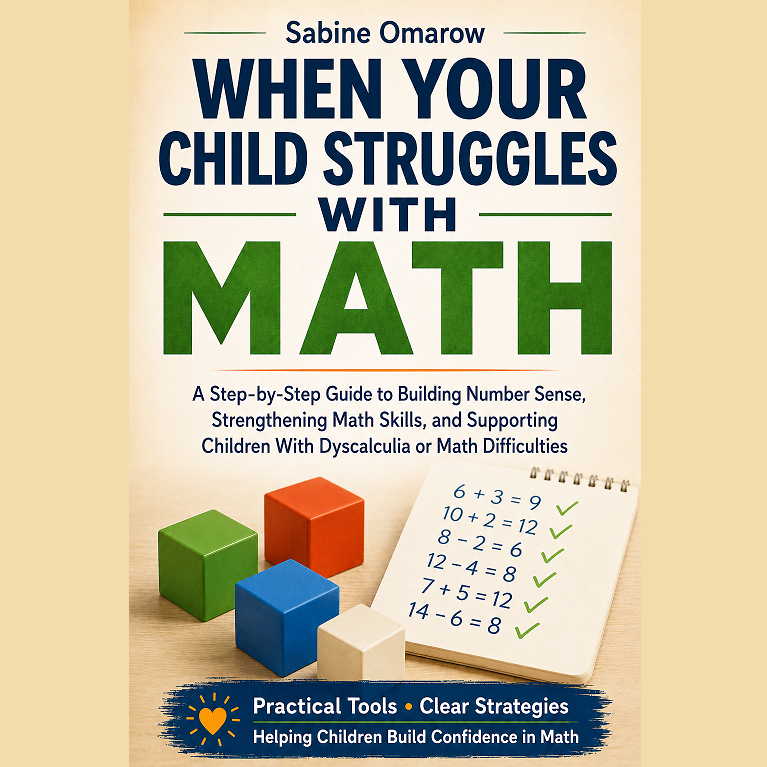
A Step-by-Step Guide to Building Number Sense, Strengthening Math Skills, and Supporting Children With Dyscalculia or Math Learning Difficulties
Does math feel like a daily struggle for your child?
Do numbers seem confusing, overwhelming, or difficult to remember, even when your child is trying hard?
You are not alone.
Many children experience challenges with number sense, basic calculation skills, and mathematical confidence. Some struggle with addition, subtraction, multiplication, or division. Others experience difficulties associated with dyscalculia or other math learning difficulties.
This practical, step-by-step guide shows parents, teachers, tutors, and learning support professionals how to build a stronger foundation in mathematics through clear explanations, visual strategies, and structured practice.
Inside this book, you will discover:
How number sense develops and why it is essential for mathematical learning
How to help children understand quantities, numbers, and relationships between numbers
Step-by-step strategies for addition and subtraction
Ways to support multiplication and division fact learning
How visual patterns, structured practice, and clear routines can make math easier to understand
Strategies to reduce frustration and support confidence during the learning process
Based on more than 22 years of experience supporting children, teenagers, and adults with math learning difficulties, Sabine Omarow shares practical approaches that focus on understanding, not simply memorizing procedures.
This book is not about making children work harder. It is about helping them discover a clearer path into mathematics.
Whether your child is struggling with weak number sense, ongoing math difficulties, math anxiety, or dyscalculia, this book provides structured guidance and practical tools to support learning step by step.
Every child learns differently. With patience, support, and the right approach, children can build a stronger relationship with mathematics.
Please note: This book is intended for educational and informational purposes only. It provides practical strategies and learning support ideas for children who struggle with math. It is not a substitute for professional diagnosis, assessment, therapy, or treatment. If you have concerns about your child’s learning development, please seek guidance from a qualified professional.
Foundations of Dyscalculia and Math Learning Difficulties
p. 012 Dyscalculia: Definition and Overview
p. 013 Math Learning Difficulties
p. 014 Causes of Math Learning Difficulties
p. 015 Genetics and Inheritance in Math Learning Difficulties
p. 016 Developmental Changes in Math Learning Difficulties
p. 018 Contributing Factors in Math Learning Difficulties
p. 019 What a Diagnosis of Math Learning Difficulties Does Not Explain
Emotional and Cognitive Aspects of Mathematics
p. 021 Math Anxiety and Emotional Stress in Mathematics
p. 023 Supporting a Child During Math Blocks
p. 026 Supporting Adults With Math Learning Difficulties
p. 028 Beliefs and Their Impact on Math Learning
p. 031 Encouragement and Motivation in Learning Mathematics
Early Mathematical Foundations
p. 033 Conditions for Overcoming Math Learning Difficulties
p. 034 Early Counting and Finger-Based Number Development
p. 037 Challenges in Writing Numbers Correctly
p. 040 Number Sense Development Using Structured Patterns (Dice Patterns)
p. 053 Decomposing Ten Until Automatic Mastery
Decomposing Ten and Flexible Calculation
p. 071 Treasure Tens – A Game to Discover Place Value
p. 078 A Short Exercise to Practice the Decomposition of Ten and Develop Flexible
Calculation Strategies
p. 079 Fast Calculation
Number Sense and the Hundred Chart
p. 082 The Role of the Hundred Chart in Mathematics Learning
p. 083 Activities and Games Using the Hundred Chart
Cognitive Processes in Arithmetic
p. 103 Similarity Interference in Arithmetic Learning
p. 104 Cognitive Overload and the Paradox of Too Many Strategies
p. 105 Introduction to Crossing Ten
p. 108 Addition Across Ten Within 20
p. 119 Subtraction Across Ten Within 20
Arithmetic Within 100
p. 129 Calculations Within 100
p. 133 Addition Within 100
p. 143 Subtraction Within 100
p. 153 Missing-Number Problems in Arithmetic
Structured Calculation Strategies
p. 159 Column Addition With a Slider
p. 164Preparation for Column Subtraction
p. 167 Column Subtraction With a Slider
p. 171 Column Subtraction With a Slider (Extended Practice)
p. 176 Progression From Grade 3 Onward
p. 181 Addition Within 1,000
p. 192 Subtraction Within 1,000
p. 201 Missing-Number Problems Revisited
p. 205 Why Some Problems Need Separate Practice
p. 222 Column Subtraction With a Slider Within 1,000
Multiplication and Division Foundations
p. 226 Multiplication Facts: Introduction and Structure
p. 229 First Steps in Learning Multiplication Facts
p. 231 The Nines Facts and Finger Strategies
p. 234 Challenges in Learning Multiplication Facts and the Role of Automaticity
p. 235 The MultiMalin Method for Learning Multiplication Facts
p. 237 Memory Techniques in Mathematical Thinking
p. 239 Applying the MultiMalin Method
p. 241 Alternative Strategies for Learning Multiplication Facts
p. 242 Games for Practicing Multiplication Facts
Advanced Multiplication and Division
p. 253 Games for Mathematical Flexibility
p. 254 Exploring Multiplication Patterns
p. 257 Multiplication With Larger Numbers
p. 259 Reading Large Numbers and the Use of Commas
p. 263 Division of Larger Numbers
p. 268 Multiplication With Two-Digit Numbers
p. 275 Partial Quotients and Halving Strategies
Decimal Numbers and Final Practice
p. 283 Multiplying and Dividing With Decimal Numbers
p. 289 Conclusion After Working Through the Book
Grid Pictures and Solutions
p. 290 Understanding Grid Pictures in Mathematics
p. 299 Solutions