
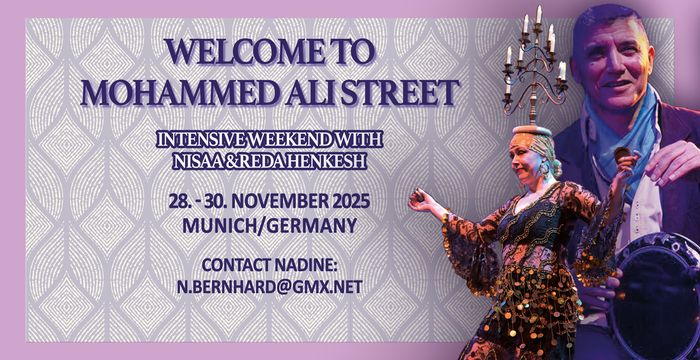
This weekend is a must for all students, dancers and teachers of Egyptian dance!
Come & learn from one of the most knowledgeable experts and researchers on the history and tradition of Egyptian dance!
7-9 pm (19-21 Uhr)
From the Street of Art: The Life and Work of a Muhammad Ali Street Entertainer
LECTURE - studio & online
In this lecture, Reda Henkesh shares his experiences and insights as a musician from Cairo's famed Muhammad Ali Street. As he recounts personal anecdotes from his career – from playing tabla at baladi weddings, to touring internationally with Egyptian superstar Muhammad Mounir, Reda reveals the unique knowledge, skills, and experiences that set Muhammad Ali Street entertainers apart. As someone who has lived through the profound changes to Cairo’s music and dance culture since the 1970s, Reda Henkesh is a witness to history, and his story is key to understanding the impact of these changes on traditional entertainers and their families. Don’t miss this opportunity to see Muhammad Ali Street through the eyes of one of its most accomplished artists!
11-12 am (11-12 Uhr)
The Awalim and the Delta Ghawazi: A Brief History
LECTURE - studio & online
The awalim and the ghawazi are Egypt’s original professional belly dancers. Long before the emergence of theatrical raqs sharqi at the turn of the 19th and 20th centuries, the singing and dancing of these women brought joy and delight to important social occasions. Well after the rise of raqs sharqi, the awalim and the ghawazi would persist in Egyptian life, even into the modern day. This lecture traces the complicated history of the urban awalim and the Delta ghawazi from the late 18th century through the 20th, based on Nisaa’s in-depth research and Reda’s personal experiences and observations of the last decades of awalim and Delta ghawazi culture.
The Awalim and the Delta Ghawazi: Music and Movement
DANCE WORKSHOP - studio
In this workshop, Nisaa and Reda guide you through a music and movement exploration of the belly dance stylization of Egypt’s urban awalim and Delta ghawazi (focusing on mid-to-late 20th century stylization). The dance style of these Lower Egyptian traditional entertainers was much more raw and exuberant than the raqs sharqi that would come to dominate in nightclubs and cinema. Frequently, the dance would incorporate gymnastic feats and spectacular balancing acts, the means by which each entertainer would set herself apart from the others. Note to students: Please bring finger cymbals if possible. There will be minimal floorwork in this class as traditional floorwork will be addressed in the Sunday workshop.
HAFLA
Join our Hafla at Laola Restaurant & Bar (Görzer Str. 55, 81549 Munich)!
More info about our program is coming soon!
58 € including main dish and small soft drink
11 am - 2 pm (11-14 Uhr)
Floorwork and Balancing Acts in Traditional Egyptian Belly Dance
DANCE WORKSHOP - studio
For generations, Egyptian belly dancers have amazed and astonished their audiences by performing acrobatic feats as part of their dance performances. In this workshop, join Nisaa and Reda for an exploration of traditional Egyptian floorwork and balancing acts, including raqsat al-shamadan, the dance of the candelabrum. Learn of the long history of these gymnastic feats in Egyptian belly dance and the ways they have changed through time, and explore how the aesthetic and technique of these acts in traditional Egyptian belly dance differ from other stylizations (e.g. theatrical folklore).
Note to students: Please bring finger cymbals if possible. A shamadan or other balancing object is not required, but if you have your own, it would be very helpful! Worried that this workshop might be too physically demanding? Please rest assured that you are welcome to attend and learn regardless of whether you can execute each and every movement! For Nisaa and Reda, it’s much more important that you learn the history and culture of these acts. So please, join us and participate in the movement practice to whatever extent you feel comfortable!
Full weekend (from 1st September): 225 €
Online only: 20 € (1h lecture), 35 € (2h lecture)
Recordings of the lectures will be available for 4 weeks.
Booking of individual workshops on request!
Hafla: 58 € including main dish & small soft drink
Location
Workshops: Studio Dance & Fight, Frankenthaler Str. 20 A, 81539 München
Closest station: München Giesing (U2/S3/S7)
Closest hotel: Hotel Bold München Giesing
For registration or if you have any questions contact Nadine: n.bernhard@gmx.net
Nisaa
Nisaa (Heather D. Ward) is a Middle Eastern dance instructor, performer, and researcher based in St. Louis, Missouri, USA. Nisaa has been conducting pioneering research into the history and development of Egyptian belly dance.
Her investigations into the transition from awalim and ghawazi dance styles to classical raqs sharqi at the turn of the 19th/20th centuries led to the publication of her first book, Egyptian Belly Dance in Transition: The Raqs Sharqi Revolution, 1890-1930, in 2018. Her latest book, Raqs in the City: The Belly Dance Landscape of Cairo, explores the historical interconnection between dance, dancers, and the city of Cairo, and was released in 2024.
Through excellent instruction, outstanding performances, and original research, Nisaa presents Middle Eastern dance as a living, dynamic folk art and a window into the rich heritage of the peoples and cultures of the Middle East. Learn more about Nisaa at www.bellydancewithnisaa.com.
Reda Henkesh
Reda Henkesh is recognized worldwide as a master of the Egyptian tabla. Hailing from Muhammad Ali Street, long recognized as the musical heart of Cairo, Reda carries on his family’s famous and respected musical legacy.
Reda has worked with some of the legends of Arabic music and dance, including singers Ahmad Adaweya, Muhammad al-Helou, and Wadi al-Safi, and dancers Nagwa Fouad, Mona al-Said, and Shoo Shoo Amin. Currently, Reda is the lead tabla player for international superstar Muhammad Mounir.
Reda is a true musical treasure, embodying generations of traditional musical knowledge, and bringing a lifetime of musical experience to every performance.